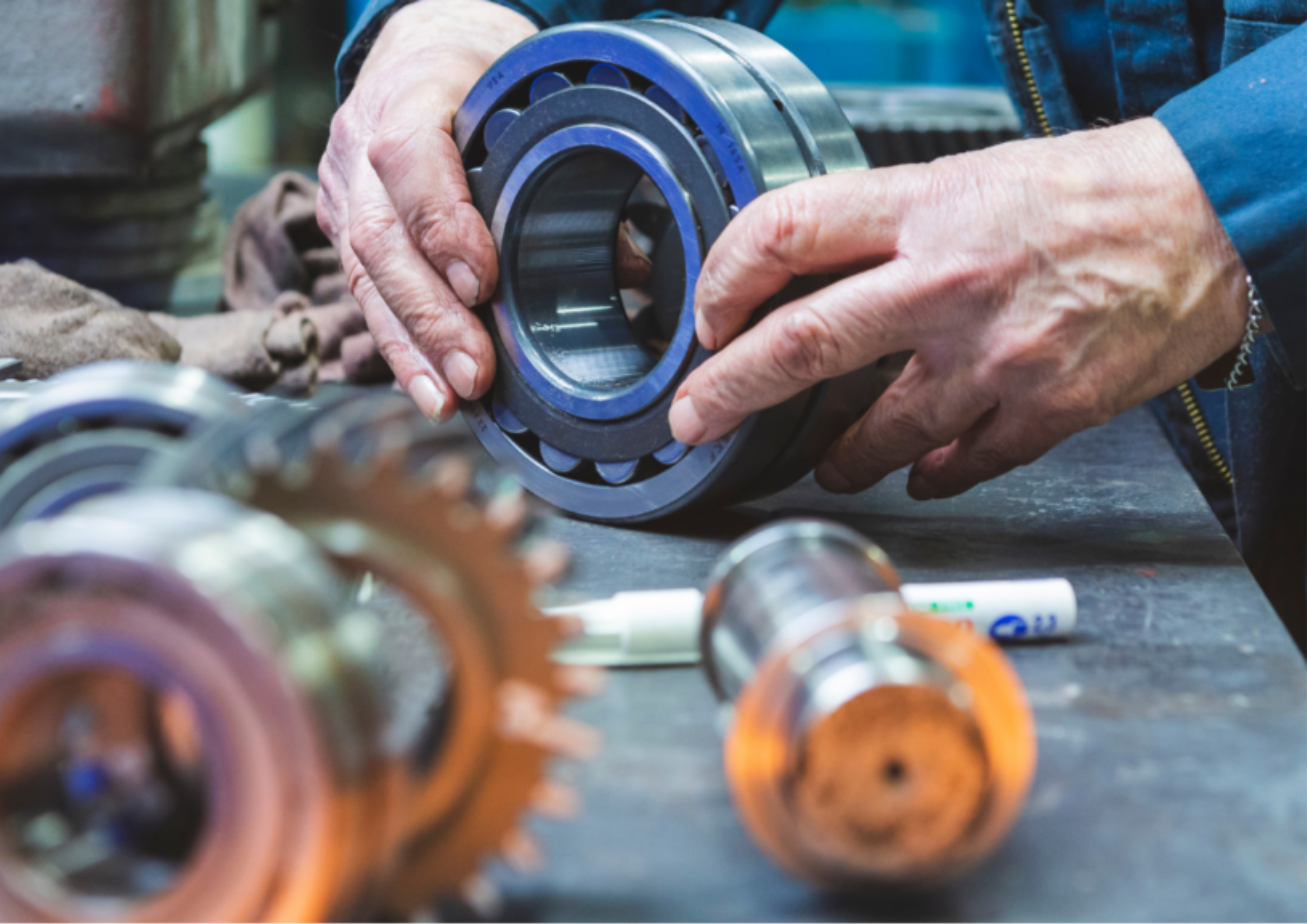
Bearing failure is one of the most common causes of unplanned downtime in industrial machinery. And in most cases, the root cause isn't poor quality, it's wrong selection. The bearing may have been completely genuine and well-made, but specified for the wrong application, overloaded, or operating in conditions it wasn't designed for.
At Masa Technologies, we supply bearings every day to engineers, maintenance teams, and procurement managers across Karnataka. The most common question we get is: "Which bearing do I need?", and the correct answer always comes back to five key factors.
Factor 1: Load Type and Magnitude
The first question is: what kind of load is the bearing handling?
- Radial loads, perpendicular to the shaft axis. Deep groove ball bearings are the standard choice for moderate radial loads.
- Axial (thrust) loads, parallel to the shaft axis. Angular contact bearings or thrust bearings handle axial loads.
- Combined loads, both radial and axial together. Angular contact ball bearings or tapered roller bearings are typically specified here.
- Heavy radial loads, spherical roller bearings and cylindrical roller bearings carry significantly higher radial loads than ball bearings of the same bore size.
Underestimating load is one of the most common specification errors. Always apply a service factor based on the application, shock loads, starts/stops, and vibration all increase the effective load on a bearing significantly.
Factor 2: Speed (RPM)
Every bearing has a limiting speed, a maximum RPM above which the cage and rolling elements generate excessive heat. Ball bearings generally have higher speed ratings than roller bearings of the same size.
Key considerations for high-speed applications:
- Check the manufacturer's speed table for the specific bearing designation
- Ceramic hybrid bearings can operate at significantly higher speeds
- Lubrication type matters: grease-lubricated bearings typically have lower speed ratings than oil-lubricated
- For spindle applications, P4 or P5 precision class bearings with matched angular contact sets are the correct choice
Factor 3: Operating Environment
Where is the bearing operating? The environment determines sealing, material, and coating requirements:
- Clean, dry environments, open bearings (no seal/shield) with periodic greasing are perfectly adequate
- Dusty environments, use rubber-sealed (2RS) or double-shielded (2Z) variants
- Wet or washdown environments, stainless steel bearings or bearings with special sealing and corrosion-resistant greases
- High temperature, C3 internal clearance, special greases rated above 150°C, and sometimes ceramic rolling elements
- Chemical exposure, stainless steel (SS) bearings or specific coatings depending on the chemical
Factor 4: Required Service Life
Bearing life is calculated using the basic dynamic load rating (C) from the manufacturer's catalogue and the actual load on the bearing (P). The standard formula (L10 life) gives the number of millions of revolutions that 90% of identically loaded bearings will achieve.
For industrial machinery, target a minimum L10 life of 20,000 to 25,000 hours. Critical continuous-operation machinery should be specified for 40,000+ hours.
If your current bearing isn't reaching target life, the problem is usually one of: overload, incorrect mounting, misalignment, contamination, or inadequate lubrication, not the bearing itself.
Factor 5: Precision Grade
For most general industrial applications, Normal (P0/C) precision class is completely adequate and is what's stocked by default. Higher precision classes are needed for:
- Machine tool spindles, P4 (ABEC 7) or P5 (ABEC 5)
- High-precision grinding spindles, P2 (ABEC 9)
- Precision instruments and measuring equipment, P5 or P4
Higher precision classes are more expensive and tighter to install, they are only worth specifying when the application actually requires them.
Bearing Type Quick Reference
| Bearing Type | Best For | Not Suitable For |
|---|---|---|
| Deep Groove Ball (6xxx) | Moderate radial + light axial, high speed | Heavy radial or shock loads |
| Angular Contact (7xxx) | Combined loads, high-speed spindles | Heavy radial loads, misalignment |
| Spherical Roller (22xxx) | Heavy radial, misalignment tolerance | High-speed applications |
| Tapered Roller (30xxx) | Combined heavy loads, gearboxes | Applications requiring self-alignment |
| Needle Roller (NA/NK) | Compact high-load, limited space | High axial loads |
| Self-Aligning Ball (12xx) | Misaligned shafts, plummer blocks | High axial loads, high precision |
Need Help Selecting a Bearing?
At Masa Technologies, we help customers cross-reference, specify, and source the correct bearing every day, free of charge. Share a photo of the existing bearing, its markings, or your machine's specifications. We'll identify the bearing, confirm the correct replacement, and give you pricing from our Bengaluru stock.
WhatsApp us a photo of the bearing or part number, we respond fast.